Commercial Disaster Restoration in Keller & North Fort Worth
Commercial disaster restoration is water, fire, storm and mold recovery phased so the business keeps trading. Best Option Restoration of Keller dispatches 24/7 with a 60-minute target arrival, contains the work zone, runs disruptive work after hours, and documents everything for property and business-interruption claims. Typical projects run $5,000–$250,000.
$5,000–$250,000 by area, occupancy and scheduling.
24/7 dispatch, 60-minute target arrival.
3–7 days drying; rebuild phased over 1–8 weeks.
ANSI/IICRC S500 · S520 · S700, commercial drying protocols.
Usually yes: containment plus phasing by zone.
Priority response agreements at no cost.
Property types, and what constrains each
The loss is rarely the hard part. The occupancy is.
Offices & professional suites
Server rooms, document recovery and network continuity come before cosmetics.
Retail & shopping centers
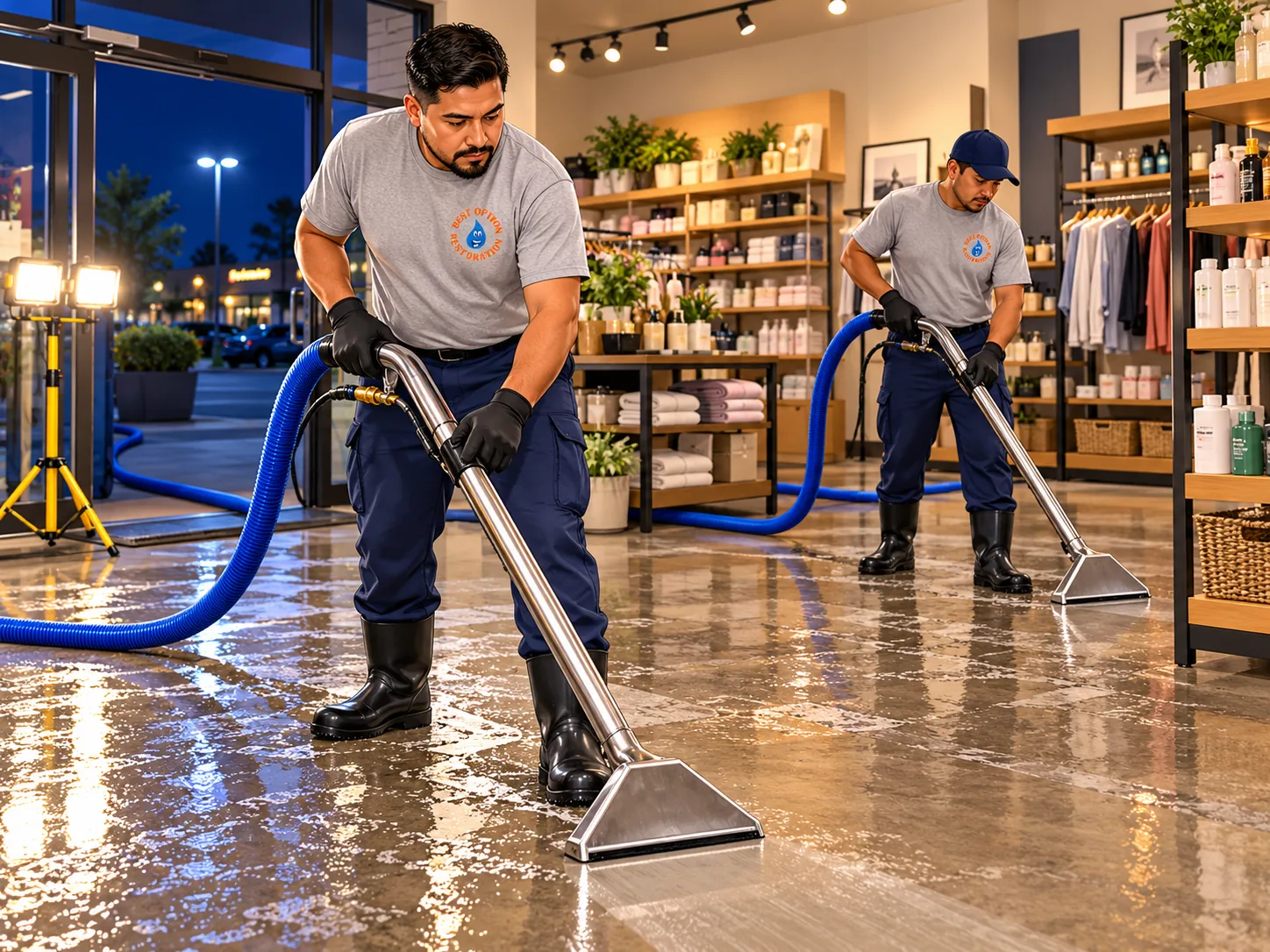
Inventory salvage and a clean, safe customer route through the space, or you lose the week.
Restaurants & commercial kitchens
Health-department reinspection drives the schedule; food-contact surfaces and equipment need specialist cleaning.
Medical & dental practices
Infection control, sterile-area protocols and patient-record protection, with treatment rooms restored in sequence.
Warehouses & light industrial
Large-volume drying, racked-inventory salvage and keeping the dock operating.
Multifamily, HOA, schools & churches
Multiple units, tenant notification and habitability: a stack loss is a dozen small projects at once.
Commercial vs residential
Same physics, different constraints, and the difference is what an unprepared contractor gets wrong.
How we keep you open, step by step
Six phases. Phase two is the one most contractors skip, and it's the one that decides whether you trade next week.
Emergency response & make-safe
Source stopped, area made safe, standing water extracted. The loss stops growing while decisions get made.
Triage by revenue impact
The building gets zoned by what it costs you to lose. Trading floor, kitchen, server room and treatment rooms before storage.
Containment that lets you stay open
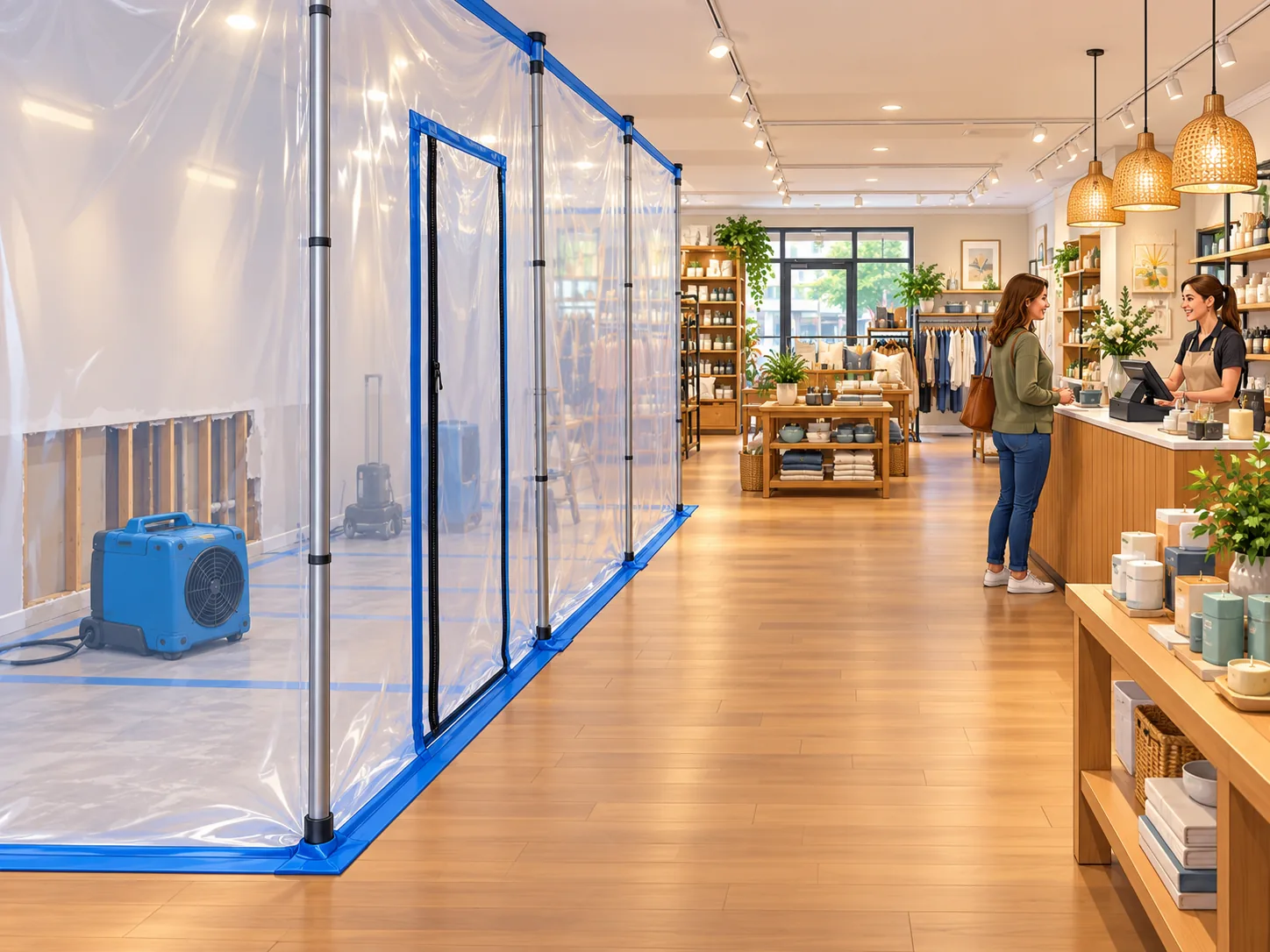
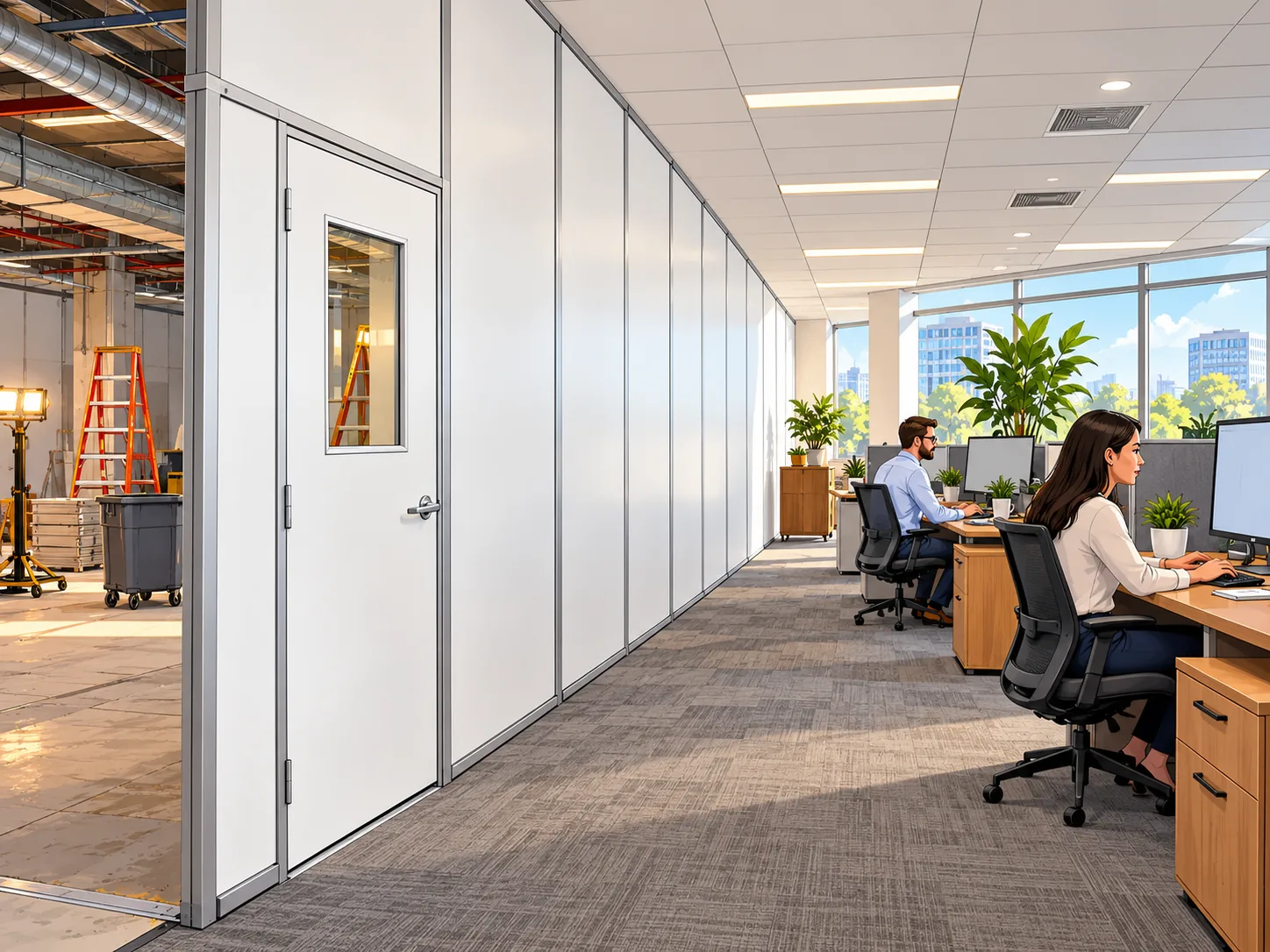
Hard containment, negative air and separate access so customers, staff and tenants keep using the rest of the building.
Phased drying & cleaning
Loud work after close or overnight. Equipment monitored daily with logged readings, not left running unattended.
Documentation for property & BI
Daily moisture logs, photographs, equipment records and a written schedule: the evidence a business-interruption claim runs on.
Reconstruction in occupied phases
Rebuild sequenced zone by zone, with code, ADA and occupancy handled through the relevant municipality.
What a commercial loss brings with it
Four compliance layers stack on a commercial job that don't exist on a house, and each one can stop the work if it's handled late.
Occupancy, permits and ADA
Commercial reconstruction in Keller, Southlake or Fort Worth triggers permitting and sometimes accessibility upgrades. Ordinance-or-law coverage is what pays for that. Ask your adjuster early, not at the end.
Health department & infection control
Restaurants need a health-department reinspection (by the city or Tarrant County Public Health, depending on location) before reopening; clinics need documented infection-control measures during work. Both drive the sequence rather than following it.
Texas mold licensing applies here too
At 25 contiguous square feet or more, an independently licensed assessor writes the protocol and a TDLR-licensed remediation contractor performs it: same rule as residential, and a real constraint on a multifamily stack loss.
Tenant habitability & notification
On multifamily and HOA properties, Texas landlord-tenant obligations run in parallel with the repair. We give you tenant-facing updates you can forward without rewriting them.
Our licenses & capability
Definitions, in one line each
Business interruption coverage pays lost income and continuing expenses while a covered loss stops normal operation.
Extra expense coverage pays the cost of temporary measures that keep you trading: rented space, generators, equipment.
Desiccant dehumidification removes moisture with an adsorbent wheel, working in large volumes and low temperatures where refrigerant units stall.
Hard containment is framed and sheeted barrier construction, not plastic taped to a doorway.
Priority response agreement is a pre-loss file of your building details, access and contacts, with an agreed rate schedule.
What commercial restoration costs in DFW
Ranges from jobs we've run across northeast Tarrant County. Reconstruction is scoped separately within the same claim.
The number that matters usually isn't on this table. For most commercial clients the restoration cost is smaller than the revenue at risk, which is why after-hours labor and extra equipment are worth paying for, and why business-interruption and extra-expense coverage should be checked in the first hour, not the third week.
We work with your insurance company
We bill your carrier directly and send your adjuster the records they ask for. You pay your deductible. Hablamos español.
Don't see your insurer? We work with them too. Just ask.
The first hour, for a facilities manager
Six steps. If you have a priority response agreement, steps three to six are already on file.
Get people out of the affected zone and rope it off. Liability first.
Shut off water at the riser or main; kill power to wet areas at the panel.
Call us and say what business you run. That determines the crew and equipment dispatched.
Photograph wide and close, timestamped, before anything moves.
Notify the carrier and ask explicitly about business interruption and extra expense.
Start a spend log from minute one. Every hour of overtime and every rental is claimable.

Commercial restoration FAQs
Can my business stay open during restoration?+
Usually yes. Hard containment with negative air pressure, separate access routes and phased scheduling let most offices, retail units and clinics keep trading while one zone is worked. Restaurants and medical practices need more care because of health-department and infection-control requirements, but even there the answer is normally partial operation rather than full closure.
How fast can you respond to a commercial loss?+
We dispatch 24 hours a day with a 60-minute target arrival across northeast Tarrant County. For property managers and multi-site operators we set up a priority response agreement in advance (building details, access, shut-off locations and escalation contacts on file), which speeds up the response because nobody is looking for a key at 2am.
How much does commercial water damage restoration cost?+
Commercial losses in DFW typically run $5,000 to $250,000. A single suite or office floor is often $5,000–$25,000, a restaurant or medical practice with equipment and specialist cleaning is $25,000–$80,000, and a multi-tenant or multi-floor event exceeds $100,000. After-hours scheduling, occupancy type and specialist equipment are the main drivers beyond square footage.
Do you work after hours and overnight?+
Yes, and for most commercial clients that's the default rather than an upgrade. Demolition, extraction and cleaning run after close or overnight, with quiet monitoring during business hours. The premium on after-hours labor is almost always smaller than a day of lost revenue.
What does business interruption insurance cover?+
Business interruption coverage pays lost income and continuing expenses while a covered loss keeps you from operating normally, and extra-expense coverage pays the cost of temporary measures such as a rented space, generator or equipment. Both depend on documentation: dated photographs, daily logs, a written restoration schedule and your own revenue records. We produce the restoration side of that record as a matter of course.
What types of commercial property do you handle?+
Offices and professional suites, retail and shopping centers, restaurants and commercial kitchens, medical and dental practices, warehouses and light industrial, schools and churches, hotels, and multifamily and HOA properties. Each has its own constraint (health-department rules, infection control, food safety, tenant notification), which is what shapes the scope.
Do you have the equipment for a large commercial loss?+
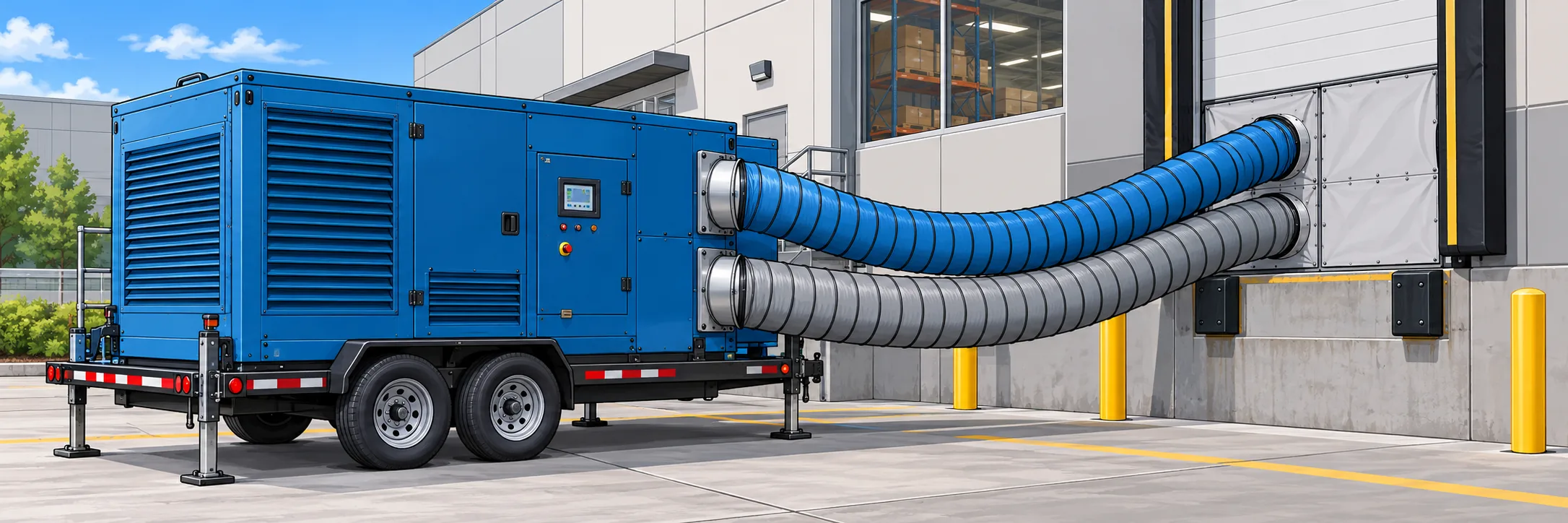
Yes. Large-loss commercial drying uses desiccant dehumidification, truck-mounted extraction, high-capacity air movers and temporary power rather than scaled-up residential equipment. On a very large event we mobilize additional resources through the Best Option Restoration network while our local project manager keeps single-point accountability.
Can you work with our property management or facilities team?+
That's the normal arrangement. You get one project manager and one phone number, daily written updates, tenant-facing communication you can forward without editing, and documentation formatted for your owner, lender or asset manager. For multi-site portfolios we hold building profiles on file so the response doesn't start with a discovery call.
What is a priority response agreement?+
A no-cost agreement set up before anything happens: your building details, floor plans, utility shut-off locations, access and key-holder information, insurance details and escalation contacts on file, with a pre-agreed rate schedule. When a loss occurs the crew is dispatched immediately with the information it needs, instead of spending the first hour gathering it.
Set up priority response before you need it
It's free, and there's no contract. Twenty minutes now saves the first hour of a loss later.
Commercial restoration near you
Commercial crews across northeast Tarrant and south Denton counties, including the north Fort Worth corridor.
Reviewed by Jonathan Dempsey, owner and lead project manager, IICRC ASD/CDS/WRT · Published September 7, 2026 · Last reviewed October 16, 2026 · Coverage descriptions are general; your policy language controls. Cost ranges reflect our own DFW projects and are not a quote.